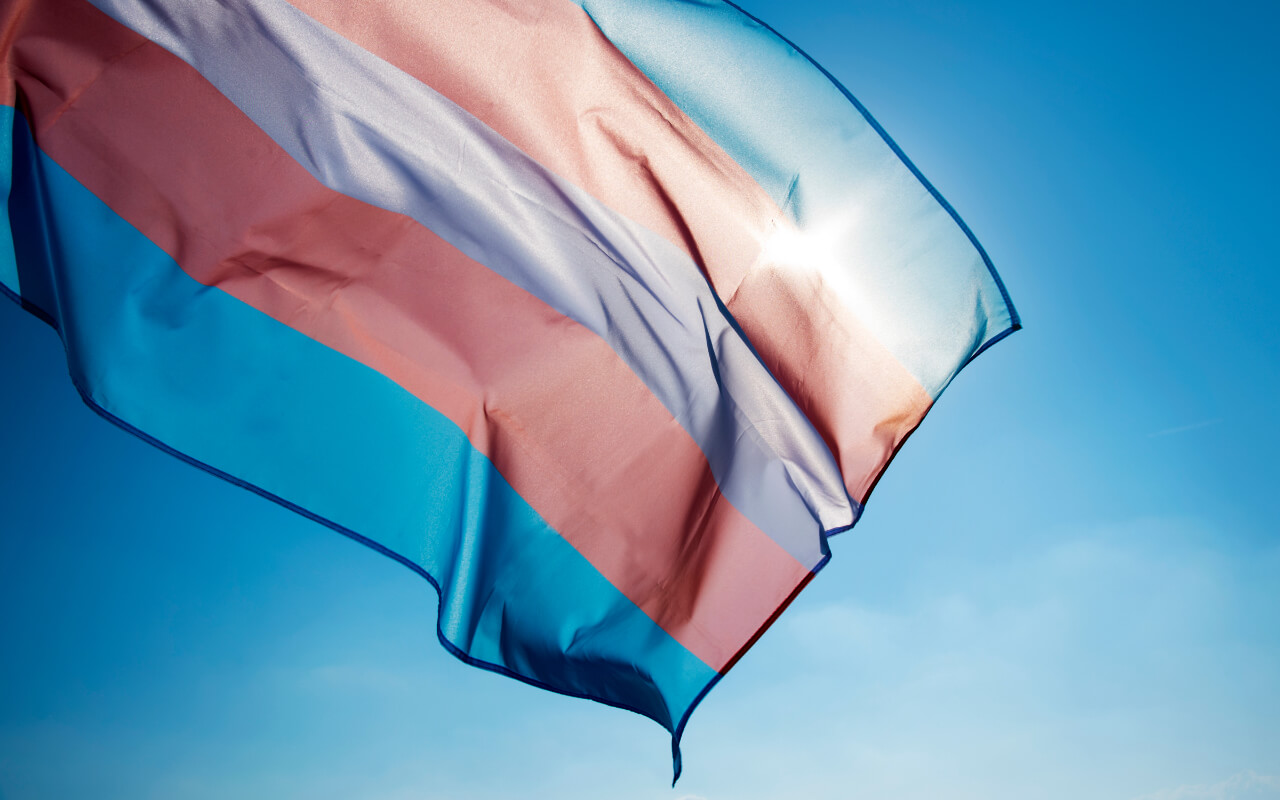
“We’re just human like everyone else. We’re putting the same blood, sweat, and tears as anyone we’re competing against. We’re just like everyone else trying to enjoy a sport.”
—Parker Parker, field hockey player, Merrimack College
Playing sports instills important values for youth, including teamwork, belonging, discipline, and self-confidence. Adults benefit from sports, too: through their athletic participation, they become more involved with their community, foster fellowship with their teammates, and achieve personal and team goals.
Although some politicians and activists have argued that trans inclusion makes sports less safe and fair, we believe that transgender people should be allowed to play alongside their peers on teams that align with their gender identity. It’s possible to ensure that sports can remain safe and fair while including transgender athletes.
This is a living document that will be updated periodically to reflect the lived realities that trans athletes face, as well as new research and information that we have identified.
FAQ
There are two ways to answer this question. The first is that it isn’t a big deal at all! Politicians and media personalities have concocted this problem and are using it as a wedge issue to get people who would otherwise be supportive allies of the trans community to agree with legal restrictions on the equal integration of transgender people into society. They’ve also found it’s a great distraction from the other terrible things they’re doing.
The second is that it’s a very big deal for transgender and nonbinary people because, at the highest level, it represents the willingness of politicians to give up on the integration of transgender people into society. There is no room for compromise on the civil rights and freedoms of transgender Americans now, just as there wasn’t in the 20th century on the civil rights of Black and Brown Americans. It is also a deeply personal attack on trans communities, using our difference as a tool of separation and exclusion from the pursuit of happiness that our forebears outlined as a key right of Americans in the Declaration of Independence. At a more personal level, it’s a big deal for trans people because we just want to play sports and participate in everyday American, and human, activities with our peers.
Proponents of these bills say that the goal is to ensure that school sports are fair and safe for everyone who participates. We agree that students should have a fair chance when they play, and that they should be safe.
This is where schools and parents come in—they know best about what’s safe and fair for their students. They should set the rules for who gets to participate in sports, not politicians. In elite sports, athletic associations set the standards. This is what is already happening in Massachusetts, and there’s no sound reason to change the policy.
What’s more, bans against participation in sports haven’t been limited to sports like swimming and track & field; they’ve also extended to chess and darts, two games that aren’t associated with competitive physical advantages or athletic ability. The goal is to exclude trans people from public life, not to ensure fairness in athletic competition.
No. Competitive advantages in sports come from extensive training, nutritional quality, physical fitness, and access to high-quality practice facilities. According to multiple scientific studies, biomedical factors related to puberty, such as bone density, testosterone levels, and lung size, do not predict athletic performance. The distributions of testosterone levels among elite cis male and female athletes overlap. Focusing on testosterone levels can also exclude some non-transgender girls from participation in school sports. For example, about 10% of women have polycystic ovarian syndrome, a condition that increases their testosterone levels.
Discussions of competitive advantage aren’t always appropriate, either. Most youth who participate in school sports aren’t training to be professional athletes or Olympians—they just want to play alongside their friends and classmates. In cases like this, schools don’t need to go through the extensive testing that elite athletic associations use.
Banning trans girls from girls’ sports may lead to invasive genital inspections and questions about menstruation. Gender-nonconforming or highly athletic non-trans girls may be stereotyped as masculine, raising suspicion that they might be trans because they don’t look or act feminine enough. These suspicions can lead to harassment and bullying, both by other students and by adults. Attitudes like this led the Algerian Olympian boxer Imane Khelif to be harassed by multiple public figures, including Donald Trump, Elon Musk, and J. K. Rowling. Although Khelif herself is not trans, anti-trans sentiment was used to discredit her athletic achievements.
Harassment, bullying, and intrusive questions aren’t the only risks that cis women and girls face when transphobic sex-testing policies are implemented. Unscrupulous coaches and other officials can use these policies as an excuse to sexually abuse the athletes being tested. Genital inspections can lead very quickly to sexual abuse—and when school athletes are involved, this is child sexual abuse.
By attacking a small minority, those promoting trans sports bans are inconveniencing, marginalizing, and abusing a much larger group of people. This is far from the stated goal of “maintaining fairness and safety in girls’ sports.”
It depends on the situation. If trans people are forced to compete in a transgender or open category instead of the men’s or women’s, then this is a kind of segregation that implies that trans people (especially trans men and women) belong to a third gender category, rather than the gender with which they identify. On the other hand, there are some people who want to compete in a separate trans or open category, especially nonbinary people who do not want to be forced to choose between the men’s and women’s categories. Trans people should be free to participate in any category that aligns with their identity. Ultimately, it’s a question of autonomy.
Most people who want to discriminate against transgender people in sports and athletics are disproportionately focused on trans women and girls. This is rooted in transphobia but also in sexism against cisgender women, since there are perceived differences in the physical abilities and constitutions of cisgender women as compared to cisgender men. This extends to transmasculine individuals, who are generally seen as less of a threat to transphobes due to their implicit sexism. In athletics and sports, this means that they don’t see a competitive advantage for trans men. This is just as problematic as accusing trans women of having “physical advantages” by seeing them as men, or “former men,” since it erases a trans man’s status and identity as a man entirely.
Trans men and transmasculine people often play on women’s teams, especially if they haven’t started masculinizing hormone therapy. If they decide to start hormones, they may lose their athletic scholarship (if they’re college students) and give up the sports they love.
Although biological distinctions seem straightforward, they’re often more complex. A surprisingly large number of people are intersex—their bodies don’t conform neatly to male–female distinctions. For example, some intersex people may have multiple sets of genitalia. Others may produce sex hormones at levels that are associated with the “opposite” sex assigned at birth, or they may not respond to sex hormones the way most people do. Intersex conditions have multiple causes, including chromosomal and hormonal differences. Examples of intersex conditions include Turner syndrome and androgen insensitivity syndrome.
Intersex people can have any gender identity. Some intersex people are also transgender—they may have been assigned one sex at birth, but they realized later on that their gender identity is different.
Women diagnosed with intersex conditions often face discrimination in sports. Examples include Caster Semenya, a Black South African Olympian runner. (Semenya does not use the label “intersex” for herself.) When she was an active runner, she was subjected to intrusive sex testing and media scrutiny because of her appearance and medical status. Although she was assigned female at birth and has a vagina, she has XY chromosomes and her body produces much more testosterone than the typical cis woman’s. World Athletics, the governing body for track & field, distance running, and other similar sports, established a rule in 2018 that women with disorders of sex development (a subset of intersex conditions) had to artificially lower their testosterone levels to compete in the women’s category for the 400-, 800-, and 1,500-meter dashes. This testosterone rule does not apply to cis women without a disorder of sexual development. Laws and policies restricting transgender people from participating in sports may also place restrictions on intersex people.
Read the Intersex Justice Project’s Framework for Intersex Justice for more.
References
Athlete Ally (2021, August 11). The future of women’s sports includes transgender women and girls. Athlete Ally. https://www.athleteally.org/wp-content/uploads/2021/08/The-Future-of-Womens-Sport-includes-Transgender-Women-and-Girls-Statement_8.11.21.pdf
Athlete Ally (2022). Transgender women athletes and elite sport: a scientific review. Athlete Ally. https://www.athleteally.org/wp-content/uploads/2023/01/CCES_Transgender-Women-Athletes-and-Elite-Sport-A-Scientific-Review-2.pdf
Epstein, D. (2020, September 18). Why I Changed My Mind About the Caster Semenya Case. Slate. https://slate.com/culture/2020/09/caster-semenya-ruling-testosterone-in-sports.html
Golodryga, B., Church, B., & Hullah, H. (2023, November 6). Caster Semenya says she went through ‘hell’ due to testosterone limits imposed on female athletes. CNN Sports. https://www.cnn.com/2023/11/06/sport/caster-semenya-totestosterone-limits-world-athletics-spt-intl/index.html
Movement Advancement Project (2024). Talking about transgender youth participation in sports. Movement Advancement Project. https://www.lgbtmap.org/file/talking-about-transgender-youth-sports-participation.pdf
Murdock, K. & Erickson, L. (2025, January 9). Talking about the “Protection of Women and Girls in Sports Act.” Third Way. https://www.thirdway.org/memo/talking-about-the-protection-of-women-and-girls-in-sports-act
Reed, E. (2025, May 11). The moderate case against transgender sports bans. Erin in the Morning. https://www.erininthemorning.com/p/the-moderate-case-against-transgender
Semenya, C. (2023, October 21). Running in a Body That’s My Own. The New York Times. https://www.nytimes.com/2023/10/21/opinion/running-body-semenya.html
Serano, J. (2024, October 30). Trans people and sports: everything you need to know. Switch Hitter. https://juliaserano.substack.com/p/trans-people-and-sports-everything
Strangio, C. & Arkles, G. (2020, April 30). Four myths about trans athletes, debunked. American Civil Liberties Union. https://www.aclu.org/news/lgbtq-rights/four-myths-about-trans-athletes-debunked
Transgender Freedom Alliance (2025, May 15). Responding to political attacks on transgender people. Transgender Freedom Alliance. https://www.sparksolutions.us/_files/ugd/a3ddc5_2eaee324c54d44c3adcb81c347e0c8a2.pdf
Turban, J. (2021, March 16). Trans girls belong on girls’ sports teams. Scientific American. https://www.scientificamerican.com/article/trans-girls-belong-on-girls-sports-teams/#