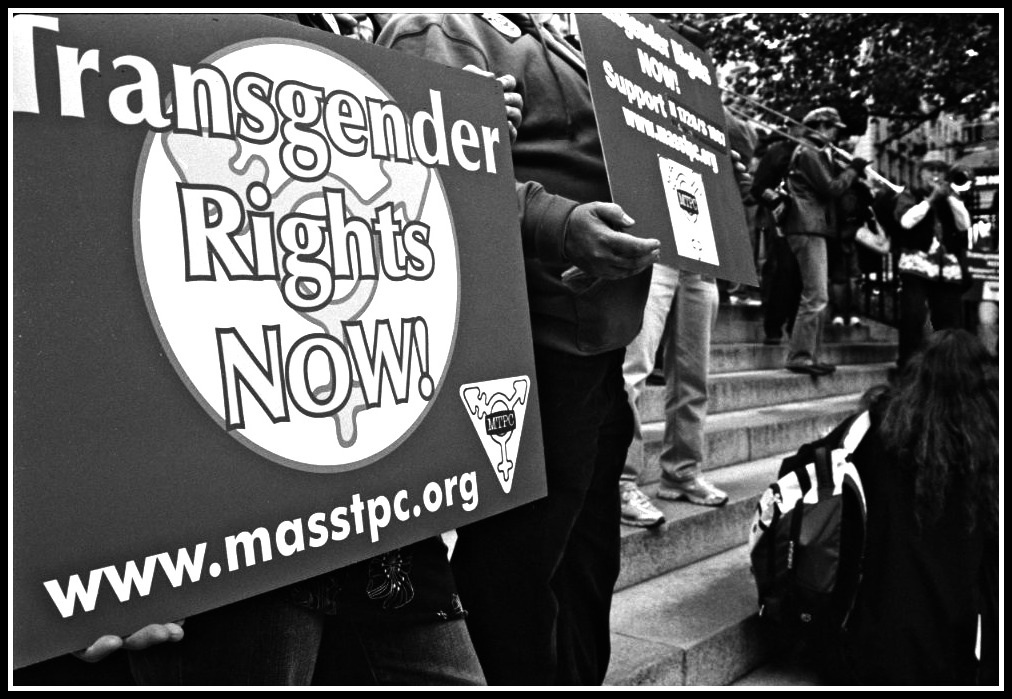
MTPC works to advance lived equity for trans and nonbinary people in Massachusetts, not just equality under the law. MTPC’s role and responsibility is to ensure that trans communities and trans rights continue to have a strong defender while providing critical support for community members impacted by oppression and violence.
2026 Advocacy & Organizing Framework
Click here to download a PDF of our 2026 Advocacy & Organizing Framework.
(Download a Printer-Friendly Version of the Framework PDF!)
Over the past year, MTPC has worked to advance policies and practices that secure the rights and lived equity of transgender, nonbinary, and gender-nonconforming people in Massachusetts. We’ve also bolstered our coalition work, partnering with organizations across the state to ensure that trans people can not just live in Massachusetts, but thrive.
We’re proud to celebrate four victories since the publication of our 2025 framework: the passage of An Act Protecting Personal Security, the launch of our Discrimination and Hate Tracker, the reestablishment of our Massachusetts Trans Interfaith Network, and the defeat of bills that would have allowed K–12 sports teams to forfeit or cancel games against trans players without penalty.
In our 2026 framework, we plan to continue the work we started in 2025 by pushing for our legislative priorities, fostering our coalition partnerships, and creating new policy and advocacy initiatives that will help sustain our community when it is under unprecedented threat by the federal government. We protect ourselves, and that principle underlies everything we do at MTPC.
I. Advocacy Priorities
These bills are our primary focus in advancing trans equity in the MA State House in 2025-2026.
- 🏳️⚧️ S.2725 An Act Establishing a Commission on the Status of Transgender People
What’s the issue?
Massachusetts has multiple laws protecting transgender and nonbinary people from discrimination, harassment, and hate crimes, but trans people continue to face hostility for their gender identity and expression. We are also lacking crucial data about the status of trans people within the state, including employment, health, economic, and educational outcomes.
How does this bill address it?
This bill will create the Massachusetts Commission on the Status of Transgender People (MCSTP), an independent state agency that will monitor the status of transgender people in Massachusetts, including, but not limited to, the implementation and enforcement of antidiscrimination laws, access to gender-affirming healthcare, insurance coverage, and accurate identity documents. This commission will operate similarly to other commissions that the legislature has established, including the Commission on the Status of Women and the Commission on LGBTQ Youth.
The MCSTP will be made up of 21 commissioners drawn from diverse backgrounds who have personal or professional experience serving or supporting trans people. More details on the makeup of the commission can be found here.
Current Status: Passed the Senate State Administration and Regulatory Oversight and Rules Committees. Now with the Senate Committee on Ways and Means.
- 🏳️🌈H.2656 An Act to Promote Rehabilitation Including Guaranteed Health, Treatment, and Safety for Incarcerated LGBTQI+ People
What’s the issue?
Incarcerated LGBTQ+ people, as well as those living with HIV, are at heightened risk for discrimination, physical violence, sexual abuse, harassment, and other forms of hostility. They are also more likely to be placed in solitary confinement than their straight and cisgender counterparts, often against their will.
How does this bill address it?
– Each state correctional facility will have an LGBTQI+ coordinator, who will ensure that incarcerated LGBTQ+ people will have safe housing; coordinate education, employment, and program placement; help people organize support groups; and ensure that HIV and LGBTQ+ publications are available for incarcerated people to read. In addition, the bill will prevent LGBTQ+ people, or people perceived as being LGBTQ+, from being housed with people who express homophobic or transphobic views.
– Furthermore, incarcerated people with a diagnosis of gender dysphoria will be housed in a single-occupancy cell if the facility is at an occupancy of 90% or lower.
– Prisons will not place people in restrictive housing or remove them from the general population for being LGBTQ+, though people can still request to be in solitary confinement for their own safety.
Current Status: Passed the House Public Safety and Homeland Security Committee. Now with the House Committee on Health Care Financing.
- 🏥 S.681/H.1188: An Act Relative to Trans-Inclusive Health Care Access
What’s the issue?
Insurance companies in Massachusetts are able to set arbitrary expiration dates for letters that certify a patient’s eligibility to receive gender-affirming healthcare. This is especially problematic for patients seeking surgeries for which hair removal is a prerequisite. In addition, many health insurance companies require at least two letters from mental health practitioners. This practice is unfair—and likely a mental health parity violation—since there are very few medical procedures that require diagnoses from two separate providers before a health plan will approve coverage. Making trans people navigate unnecessary bureaucracy like this is burdensome and inequitable, and it may prevent people from accessing vital healthcare.
How does this bill address it?
This bill will bar insurance companies from setting arbitrary expiration dates for letters certifying a patient’s eligibility to receive gender-affirming care and prevent them from requiring more than one of these letters.
Current status: Passed the Senate Committee on Financial Services. Now with the Senate Committee on Health Care Financing. - Other Bills We Support
- S.2640/H.4611 An Act to Increase Access to Disposable Menstrual Products
- S.2134/H.3351 An Act Promoting the Civil Rights and Inclusion of American Muslims in the Commonwealth
- S.340/H.656 An Act Relative to Healthy Youth
- H.4665 An Act Relative to LGBTQ+ Inclusive Framework
- S.715/H.4550 An Act Relative to Modern Family Building
- S.869/H.1360 An Act Relative to Preventing Discrimination Against Persons with Disabilities in the Provision of Health Care
- H.1747 An Act Relative to Safe Reporting
II. Organizing Strategies
🎯 Establishing the Massachusetts Trans Advocacy Task Force (TATF)
Multiple organizations across Massachusetts dedicate themselves to promoting the rights and lived equity of transgender and nonbinary people, but their coalition-building is often ad hoc and decentralized. MTPC’s goal is to change this through the Massachusetts Trans Advocacy Task Force, which will coordinate efforts across the Commonwealth to support trans people in living authentic lives without fear or discrimination, harm, or abuse. We will bring together community members and organizations to provide policy recommendations, respond rapidly to an ever-shifting state and federal landscape, support or oppose relevant legislation, and other tasks aligned with our mission.
📚 Developing an Intersectional Trans Civic Education Curriculum
We’ve developed a trans-focused intersectional civic education curriculum to provide urgent and required development to community leaders, organizers, activists, volunteers, and supporters. We believe that this is a key step in building unity, fellowship, and collaboration on our journey toward collective liberation. This curriculum will cover the basics of American government; advice on providing testimony and public comments; media literacy; the history of the queer and trans liberation movement; the intersections of all liberation and justice movements; and our vision for joyous, sustainable, and thriving new trans futures.
💵 Creating the Massachusetts Trans Economic Empowerment Coalition (MTEEC)
Trans and nonbinary people are more likely to experience economic hardship than their cis counterparts—they’re more likely to be unhoused, lack employment, and live in poverty. Even in Massachusetts, many of our community members struggle to find and maintain employment and housing. Our hope is to work alongside employment agencies, legislators, financial services organizations, financial educators, and community members to boost trans people’s economic potential through innovative policies and practices.
🏥 Expanding the Massachusetts Trans Health Coalition (MTHC)
Since 2014, MTPC has facilitated and led the Massachusetts Trans Health Coalition to hold a collaborative space for healthcare providers and advocates to advance their priorities for protecting and expanding access to gender-affirming healthcare in Massachusetts. We are working to expand this coalition to include opportunities for patients and community members to get involved and create a governance structure for the coalition to be more autonomous.
📊Distributing the 2026 Community Needs Assessment
In 2019, we launched the first Working for Lived Equity (W4LE) Community Needs Assessment, in which we learned from our community about what they needed to thrive and flourish. The data we gained from this project helped inform years of advocacy, organizing, and programmatic decisions at MTPC. In 2026, we will be launching a second W4LE Community Needs Assessment to find out what has changed for our community since 2019, reach even more trans and nonbinary Bay Staters, and gather the information and data that we’ll use to help develop MTPC’s future advocacy priorities and our 2028-2033 Strategic Plan!
🧳 Creating Supports for Immigrants, Refugees, and Asylum Seekers
Immigrants, refugees, and asylum seekers have faced unprecedented attacks on their rights, dignity, and personhood under the current administration—and this is especially dangerous for trans immigrants. MTPC hopes to partner with immigrant, refugee, and asylum seeker organizations in Massachusetts to produce Know Your Rights materials, trainings, and other resources.
🏅 Educating Legislators, Educators, and Community Members about Trans and Intersex Participation, Inclusion, and Integration in Sports
This year MTPC will be working with transgender athlete Schuyler Bailar to push back against the fallacies and disinformation that are being spread about transgender and intersex inclusion and participation in sports and athletics. Together we’ll develop FAQs, explainers, and toolkits to disarm disinformation, debunk misconceptions, and educate community members and allies, as well as government officials, school and team leaders, and athletes about the importance of trans and intersex integration in sports and athletics.
III. 2025 Advocacy and Organizing Victories & Progress
1. An Act Protecting Personal Security
In 2025, a coalition led by MTPC and GLAD Law successfully pushed for new legislation that makes legal name changes in Massachusetts safer, cheaper, and more private. Before An Act Protecting Personal Security was passed, people legally changing their names in Massachusetts had to publish notice of their name change in a local newspaper chosen by the judge presiding over their case. Their name change records were also publicly available unless a judge approved a separate motion to impound the record. This process was outdated, expensive, burdensome, and dangerous for vulnerable people, including transgender and nonbinary people, as well as survivors of abuse and stalking.
2. Reestablishing the Massachusetts Trans Interfaith Network (MTIN)
The Massachusetts Trans Interfaith Network convenes clergy, staff at faith-based organizations, and laypeople to harness the power of faith to promote the rights, dignity, and inclusion of trans Bay Staters. At a time when religion is frequently weaponized to disenfranchise trans, nonbinary, and gender-nonconforming people, it is especially crucial to provide a counterpoint to that narrative. In summer 2025, we reestablished the network, which consists of over forty members.
3. Defeating Sports Ban Bills
Alongside coalition partners like Transhealth, MassEquality, and PFLAG of Greater Boston, we helped defeat a set of bills that would have allowed primary and secondary sports teams to forfeit games played against transgender and nonbinary students.
4. MTPC Hate and Discrimination Tracker
In summer 2025, we launched the MTPC Hate and Discrimination Tracker, which is a secure database that monitors cases of discrimination, hate, harassment, and abuse directed at transgender, nonbinary, and gender-nonconforming people in Massachusetts. Through these reports, we are learning that although we have many protections on paper, there is still much that needs to be done to ensure that trans people can live safely in our state.