We are excited to announce our upcoming 2026 Financial Wellness & Literacy Curriculum! Please see below for more details.
The Trans Leadership Academy seeks to alleviate major hurdles that trans and non-binary individuals face due to disproportionate rates of unemployment, incarceration, poverty, and houselessness among gender expansive populations, particularly for BIPOC trans people who face intersectional discrimination. This program will focus on providing trans and nonbinary individuals with skills, knowledge, experience, and support that they are often not afforded the privilege of gaining in traditional educational or workplace settings due to the aforementioned issues. By supporting trans people with workforce development, mentoring and training, and material and financial support in an affirming environment we hope to alleviate the issues of unemployment, economic inequity, incarceration and recidivism.
MTPC 2026 Financial Wellness & Literacy Curriculum
Curriculum Educational Priority: Be the CEO of Your Financial Journey
Curriculum Values:
This curriculum is grounded in growth, knowledge, self-determination, accessibility, compassion, and sustainability—centering dignity, choice, and practical empowerment at every stage of the financial journey.
Curriculum Core Learning Areas:
- Understand Money
- Build Financial Stability
- Grow Money
Schedule & Timeline
| Session | Session Date |
| Navigating Tax Season with Confidence #1 | February 18th |
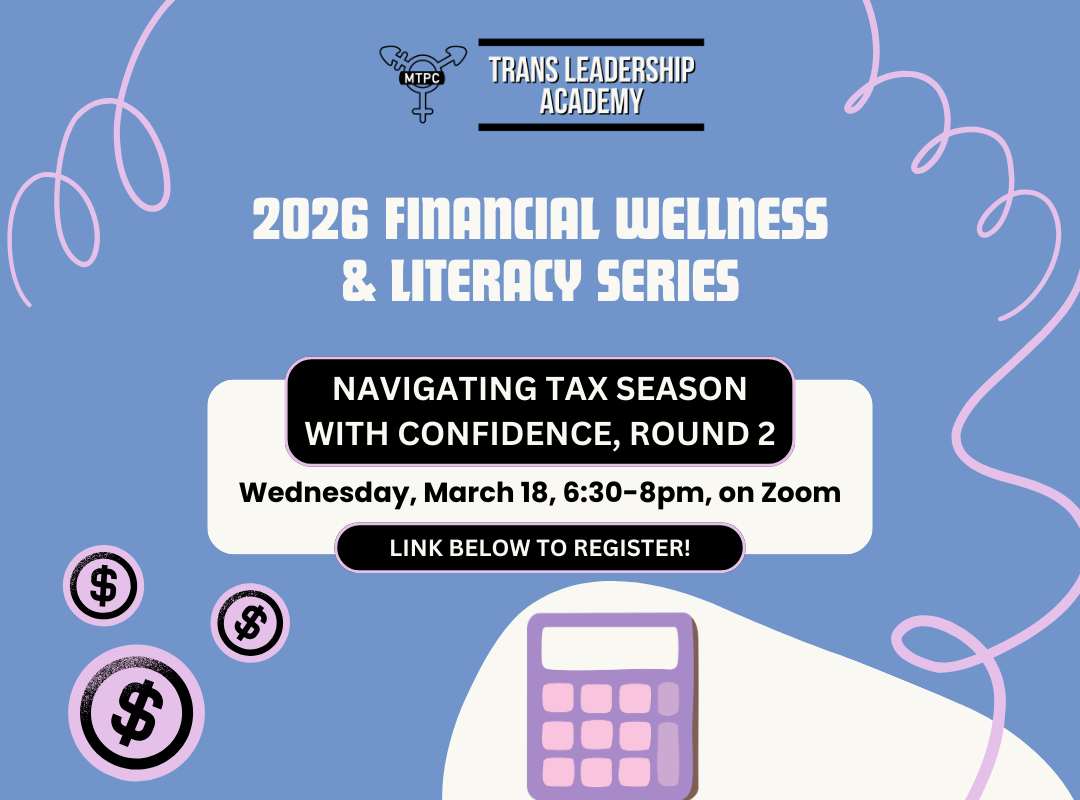
| Navigating Tax Season with Confidence #2 | March 18th |
| Taking Money Out of Financial Wellness | April 15th |
| Money Wellness 101: Foundations for Financial Stability Session 1: Budgeting & Savings Session 2: Credit & Debt Management Session 3: Financial Systems & Self-Protection | May 6th May 13th May 20th |
| Introduction to Investing & Passive Money Growth | June 17th |
| Wednesdays, 6:30 – 8:00 pm (ET), via Zoom | |
Frequently Asked Questions
Eligibility and Application
Who is the target audience?
- BIPOC, low-income, and/or formerly incarcerated trans people who live or work in Massachusetts.
What prior educational and/or work experience do I need?
- No previous work or educational experience is required, though this program requires some reading and writing.
If I have been a TLA participant previously, am I eligible to apply again?
- If you were a member of the first TLA cohort in 2023 or if you attended the 2025 Financial Literacy Series, you may be eligible to apply for a “Part 2” track in the future. However, previous participants will not be eligible to apply for the same track again.
Programming
What materials will I need?
- You will need a device that can access Zoom.
Will sessions be recorded?
- No, sessions will not be recorded.
Program Background
In 2019, MTPC conducted the Working for Lived Equity (W4LE) community needs assessment to gain a greater understanding of the needs of the community and better inform our work. At least half of all respondents identified employment, housing stability and homelessness, and paying bills and emergency funds, as among their top 3 concerns regarding basic needs. TNBGE people face some of the highest rates of economic inequities across the state and nationwide. The experiences of transphobia, cisheteronormativity, racism, sexism and misogyny often push TNBGE youth out of schools and into prisons. Many TNBGE youth and young adults are forcibly disconnected from the educational resources that lead to employment opportunities. As a result, some resort to survival economy like sex work, theft and participate in the drug trade to provide for themselves and their families, putting them at greater risk for interactions with law enforcement and incarceration.
Through workforce training, community counseling and program support, adult TNBGE people (including those who were formerly incarcerated, do not have stable housing or employment) will have developed a career / life plan with clear and attainable goals, will have attained work experience (ideally paid but potentially internships), and have achieved or ready to achieve the necessary certifications, licensing, apprenticeships or other educational attainment they would like to pursue. Ideally, adult TNBGE people who complete this program will have drastically reduced rates of incarceration, recidivism, unemployment and homelessness, and will be on the path to financial independence.
TNBGE youth who participate in this program will be on track for the job placement or educational attainment that they desire. This will include a career / life plan with clear and attainable goals through community counseling, higher education application support and counseling, and develop skills through internships or volunteer work. Ideal outcomes include significantly reduced likelihood of incarceration, homelessness and unemployment and increased rates of secondary education completion and continuing education.